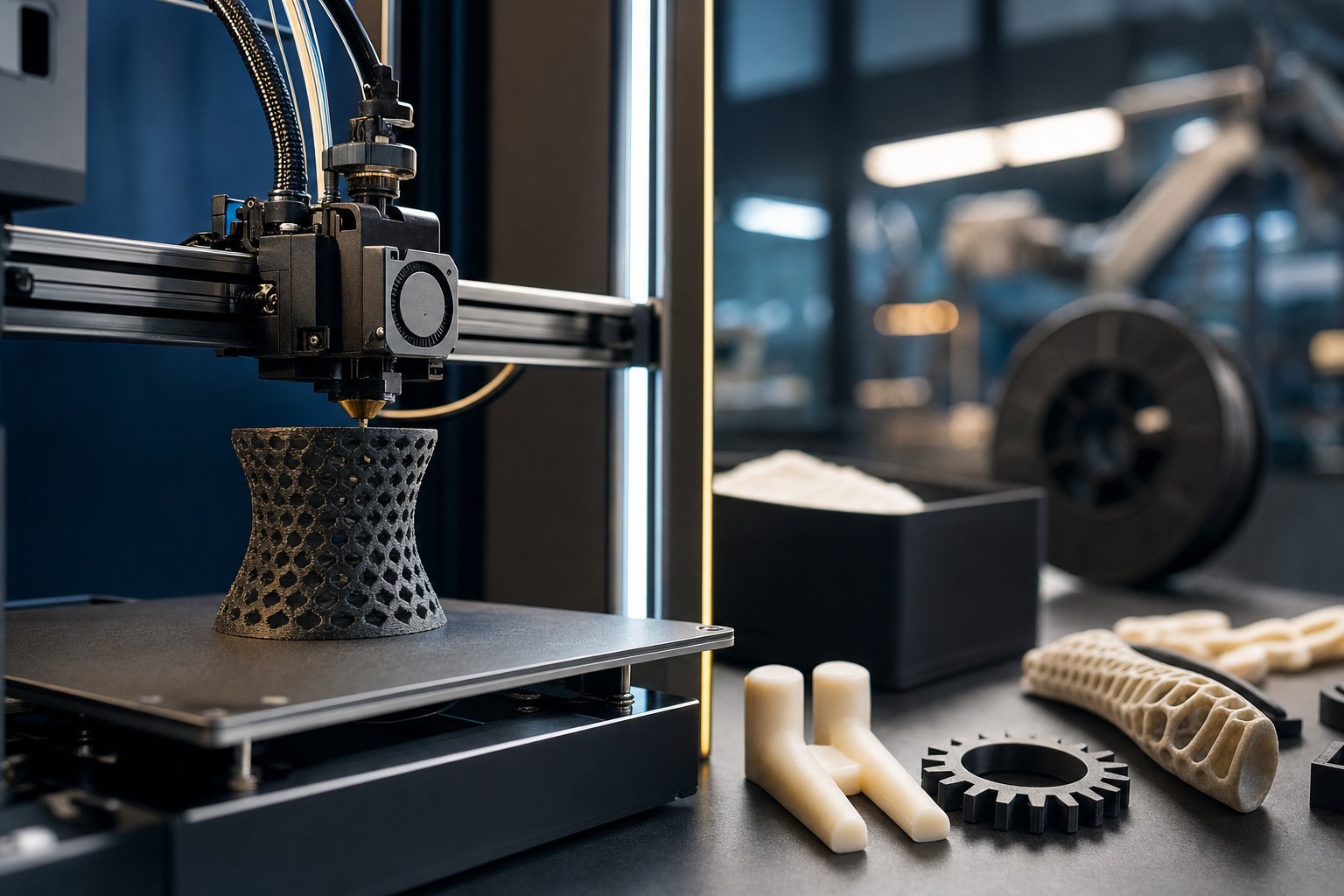
4D printing shape memory polymers applications represent one of the more technically substantive developments in additive manufacturing: structures printed in three dimensions that change shape predictably over time when exposed to a specific stimulus. The fourth dimension is time — or more precisely, a programmed structural response to heat, moisture, light, or pH. This article breaks down how the technology works, which material classes are involved, and where it is producing real results across three industries.
What Is 4D Printing, and How Do Shape Memory Materials Work?
The term “4D printing” was introduced by Skylar Tibbits at MIT’s Self-Assembly Lab around 2013. The core concept: use standard additive manufacturing processes (FDM, PolyJet, SLA) to print objects with geometry and material composition intentionally designed to deform into a second shape when triggered.
Two primary material classes enable this:
Shape Memory Polymers (SMPs)
SMPs have two stable states — a permanent shape encoded during fabrication and a temporary shape imposed through mechanical programming. The transition between them is governed by a switching temperature, often the glass transition temperature (Tg) or a crystalline melting point.
The cycle works as follows:
- The polymer is heated above its Tg and deformed into a temporary shape.
- Cooling locks in that temporary shape.
- Reheating above Tg releases the stored strain, and the material recovers toward its permanent shape.
Printable SMPs include polyurethane-based resins, polycaprolactone (PCL), polylactic acid (PLA), and various crosslinked hydrogels. Switching temperatures can be tuned from roughly 30°C to above 100°C depending on formulation.
Shape Memory Alloys (SMAs)
Nitinol (nickel-titanium) is the most clinically established SMA. It undergoes a reversible martensitic phase transformation — austenite at higher temperature, martensite at lower — that produces substantial recoverable strain. Nitinol wires and tubes are embedded in printed composite structures to create actuated components, though the alloy itself is not printed in bulk using standard additive processes.
Aerospace: Deployable Structures and Morphing Geometry
In aerospace, the constraint is volume. Structures must fit inside a fairing or cargo bay and then expand to functional geometry on deployment. SMPs and SMP composites have been investigated for:
- Deployable booms and antennas: A folded SMP lattice can be packaged at ambient temperature after shape-programming, then heated (or exposed to direct solar radiation in low Earth orbit) to recover full deployed geometry.
- Morphing wing skins: Variable-geometry aerodynamic surfaces require materials that can hold a deformed shape under load, then reset. Carbon-fiber-reinforced SMP composites provide structural stiffness in both states while enabling the transition.
- Self-releasing fasteners and covers: Components designed to open or close at a threshold temperature reduce reliance on motors and pyrotechnic actuators.
The principal engineering challenges are recovery force (the stress an SMP exerts while returning to its permanent shape) and cyclic fatigue. Most current SMP formulations degrade in recovery accuracy after repeated thermomechanical cycles, which limits use in high-duty-cycle applications. Research is active in crosslink density optimization and fiber-reinforced composite architectures to address this.
Soft Robotics: Programmable Actuation Without Motors
Conventional robotic actuators rely on rigid components — motors, gears, linkages. Soft robotics replaces these with compliant structures, and 4D-printed SMPs are a natural fit.
Thermally Actuated Grippers
A flat SMP sheet programmed to curl into a gripping geometry when heated above its switching temperature can function as a simple end effector. By printing multi-material structures (using PolyJet or similar multi-material FDM), engineers can create spatial gradients in stiffness and switching temperature, producing complex folding sequences from a single thermal input.
Hydrogel-Based Actuators
Hydrogels swell anisotropically when immersed in water, producing bending in a direction determined by the printed fiber architecture. Bilayer structures — one layer that swells strongly, one that does not — generate predictable curvature. These are particularly relevant for soft robotic swimmers and grippers in aqueous environments, where electric motors are difficult to seal.
Magnetic-Responsive Composites
Printing ferromagnetic particles into a polymer matrix and curing under an applied magnetic field encodes a preferred magnetization direction. External magnetic fields then actuate the structure remotely. This approach avoids the need for any tethered power source or thermal input, which matters in confined or inaccessible environments.
Biomedical: Where 4D Printing Shape Memory Polymers Applications Have the Most Near-Term Impact
The biomedical field offers conditions — predictable body temperature, aqueous environment, biological fluid chemistry — that align well with SMP switching parameters.
Self-Expanding Stents and Implants
Nitinol stents have been clinically used for decades: compressed for catheter delivery, expanding to functional diameter at body temperature. 4D-printed polymer analogs — biodegradable SMPs based on PCL or polyurethane — are under investigation for temporary scaffolding applications where permanent metal implants are undesirable. The device is delivered in a compressed temporary shape and recovers to its designed geometry in situ.
This intersects directly with bioprinting scaffolds work, where the goal is not just geometry but a scaffold that can match the mechanical and degradation properties of the surrounding tissue over time.
Drug Delivery
SMP capsules or patches can be programmed to open — exposing a drug reservoir — at a threshold temperature or pH. This enables localized, time-delayed release without electronic control systems. Researchers have demonstrated thermoresponsive drug delivery constructs based on printed PLA and PCL blends.
Minimally Invasive Surgical Tools
Instruments that can be introduced in a low-profile temporary shape and then deployed to functional geometry at the surgical site reduce incision size. Shape memory sutures that self-tighten as they warm to body temperature are one example already in clinical use, primarily using Nitinol wire.
The broader vision — printed biodegradable constructs that remodel in response to mechanical loading or biochemical cues — is central to work on smart biomaterials and represents a longer-horizon but technically credible target.
Current Limitations
- Recovery force: SMPs generate lower actuation forces than SMAs or pneumatic systems. High-load applications remain outside practical reach.
- Cycle life: Thermomechanical fatigue degrades shape memory fidelity. Most reported demonstrations involve one or a few cycles.
- Printing resolution vs. geometry complexity: The folding sequences achievable depend on print resolution and material distribution precision. Sub-millimeter features are achievable on SLA and PolyJet platforms but not on most FDM systems.
- Regulatory pathway: For biomedical applications, biodegradable SMP implants must clear biocompatibility, degradation product safety, and device performance standards — an extended timeline relative to research publication.
Summary
4D printing shape memory polymers applications are technically sound and advancing across aerospace, robotics, and biomedical domains. The aerospace case is driven by packaging constraints. Robotics benefits from compliant, motorless actuation. Biomedical applications leverage predictable physiological triggers and tolerance for biodegradable materials. The field’s near-term ceiling is mechanical — recovery force and cycle life — rather than geometric or chemical. Progress on fiber-reinforced SMP composites and multi-material printing resolution is where the meaningful advances are being made.